
Drainage and Yield in Ontario
Ontario receives 800–1000 mm of precipitation annually, with a significant portion falling during the spring and fall when soil moisture is already at or near field capacity. On the heavy clay soils that dominate southwestern Ontario's most productive agricultural regions — Brookston clay, Beverly clay loam, Toledo silty clay, Haldimand clay — natural internal drainage is extremely slow. Without systematic tile drainage, these soils would remain saturated well into the growing season.

Aging Infrastructure
Approximately 70% of Ontario's prime agricultural land is tile drained. However, much of this drainage infrastructure was installed 30–50 years ago. A tile system installed at 18 m spacing in the 1970s was considered adequate for 120 bu/ac corn. Today, those same fields are expected to produce 200+ bu/ac.
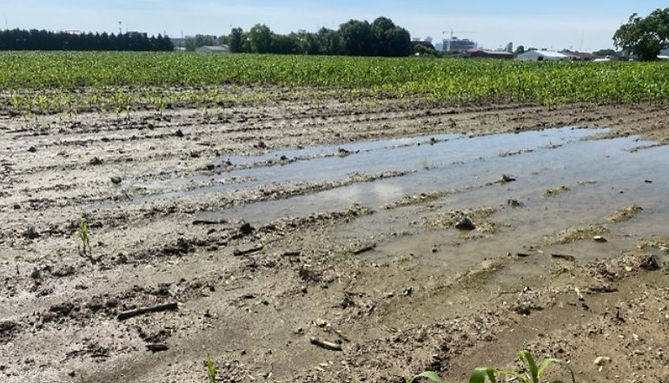
How Drainage Problems Reduce Yield
-
Delayed planting — Every day of planting delay after the optimal window costs approximately 1–1.5 bu/ac of corn yield. Poorly drained fields may be delayed 7–14 days, representing a 10–20 bu/ac penalty before the crop even emerges.
-
Root zone saturation — Corn roots begin to suffer damage after 24–48 hours of saturation. Prolonged saturation (3+ days) can kill root tissue and increase susceptibility to Pythium and Phytophthora.
-
Nitrogen loss through denitrification — On poorly drained Ontario clay soils, denitrification can remove 20–50% of applied nitrogen fertilizer — a direct financial loss of $25–60/ac at current nitrogen prices.
-
Reduced soil temperature — Wet soils are cold soils. A 2–3°C difference translates to 3–5 days of delayed germination.
-
Harvest difficulties — Poorly drained fields cause rutting, equipment damage, and soil compaction during fall operations.
Common Drainage Problems Identified by the FHCU

Common Problems We See
-
Wide tile spacing — Older systems at 15–20 m spacing. Current OMAFRA recommendations for Brookston clay call for 8–10 m spacing.
-
Shallow tile depth — Tiles at 60–70 cm provide less control than modern 80–100 cm installations.
-
Blocked or crushed tiles — Older clay tile lines deteriorate: joints separate, tiles crack, roots infiltrate and block lines.
-
Inadequate surface drainage — Depressions, swales without grade, blocked surface inlet risers.
-
Outlet problems — Silted-up municipal drains, submerged outlets, erosion damage.
The Economics of Drainage Improvement
YIELD RESPONSE
20-40 bu/ac corn
$110–220/ac additional annual revenue
REDUCED N LOSS
20–30 kg N/ha savings
$15–25/ac in fertilizer costs annually
EARLIER PLANTING
5–10 days earlier
Capturing full optimal planting window benefit
LOW DRYING COSTS
3–7 days earlier maturity
Reduced per-bushel drying costs
Modern tile installation in Ontario costs $1,200–1,800/ac depending on spacing, depth, and soil conditions. At a yield benefit of $150–200/ac annually, the payback period is typically 6–10 years — with benefits lasting 30–50 years. See the full ROI analysis.
Key Takeaway: The FHCU provides the diagnostic evidence needed to justify drainage investment and target it where it will generate the greatest return — rather than investing in drainage on fields where other factors (like compaction) are the primary yield limiters.
Drainage and the FHCU 3-Field Comparison

What This Means on Your Farm
One of the most powerful uses of the FHCU's 3-field approach is isolating drainage as a yield-limiting factor. When your highest-performing field has 10 m tile spacing at 90 cm depth, and your lowest-performing field has 18 m spacing at 70 cm depth — on the same soil type — the diagnosis is clear and the investment decision is straightforward.
The FHCU drainage assessment considers tile spacing, tile depth, tile condition, surface drainage adequacy, and water infiltration rate. Each field receives a drainage score that, when compared across your three fields, reveals whether drainage is a significant contributor to the yield gap you're experiencing. Book your free assessment →

The Sustainable Canadian Agricultural Partnership is a five-year (2023-2028), $3.5- billion investment by federal-provincial and territorial governments to strengthen competitiveness, innovation, and resiliency of the agriculture, agri-food and agri-based products sector.
.png)